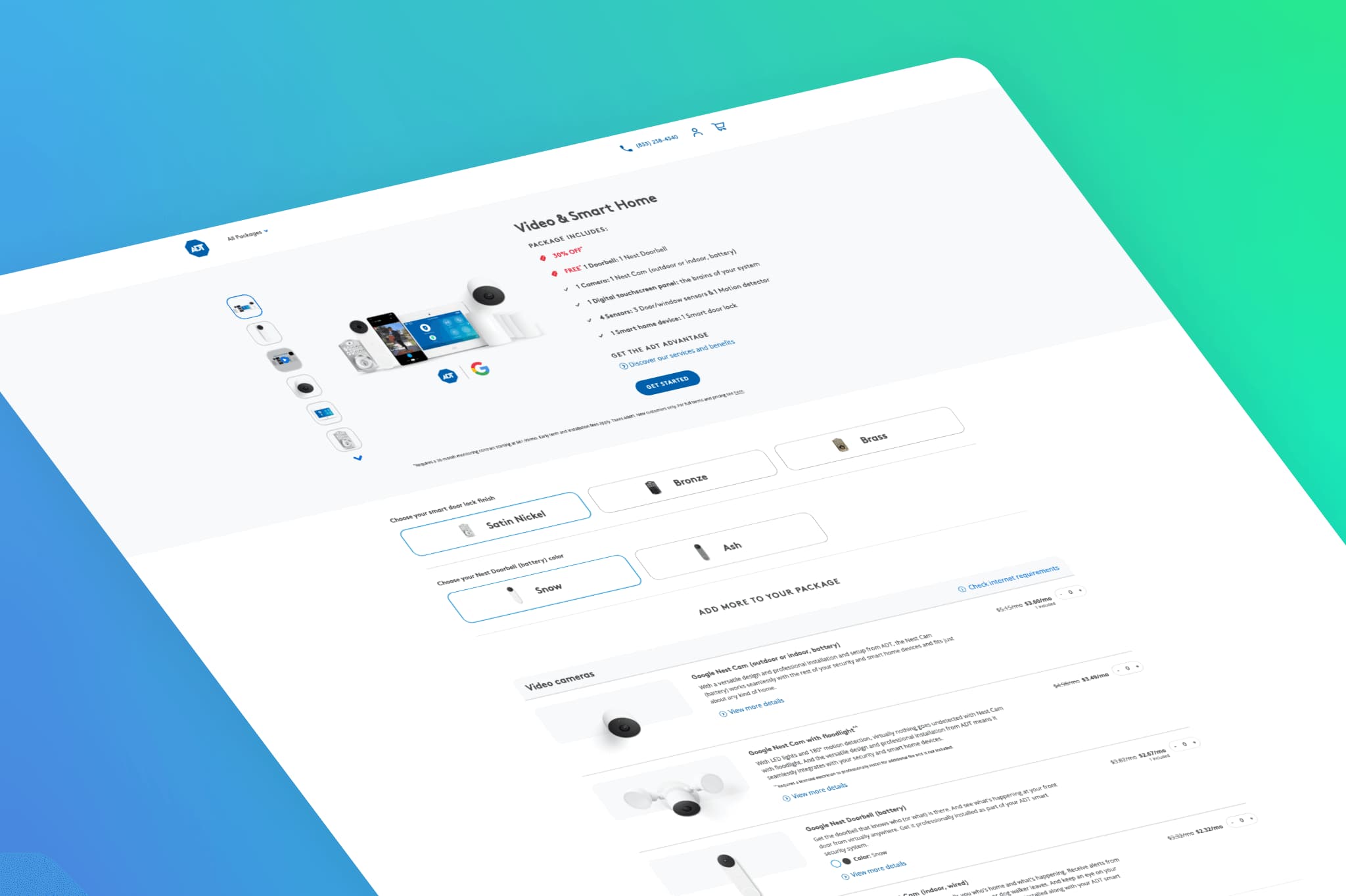
ADT E-commerce PDP Optimization
Led strategic redesign of ADT's product detail pages, driving a 400% year-over-year increase in e-commerce sales by surfacing the right product information at the right moment in the purchase decision.
- Team
- 1 UX Lead1 UXR1 UXD1 PM
- Timeline
- Multiple sprints, Spring 2022
- Category
- E-commerce
- Impact
- 400% YoY e-commerce sales increase
Published: Jun 2022
TL;DR
ADT's product detail pages were losing customers who were interested enough to visit but not confident enough to buy. I led a research-driven redesign that surfaced the right product information — through image carousels, a USP drawer, and detailed component breakdowns — and launched across Spring 2022. The result was a 400% year-over-year increase in e-commerce sales, validated by both behavioral analytics and qualitative user testing.
Context & Challenge
The Business Problem
As Director of Product Design, I led the strategic vision of this project — overseeing the UX and UI team, directing research, shaping the solution strategy, and owning communication with the executive team.
After observing fallout in the ADT e-commerce conversion funnel, my team was tasked with improving the conversion rate from the Product Detail Pages (PDP) to the cart. Users were arriving at product pages and leaving without buying — a direct revenue leak that leadership wanted addressed.
The core question: what was stopping people who were clearly interested enough to view a product from adding it to cart?
Research & Discovery
Behavioral Analytics
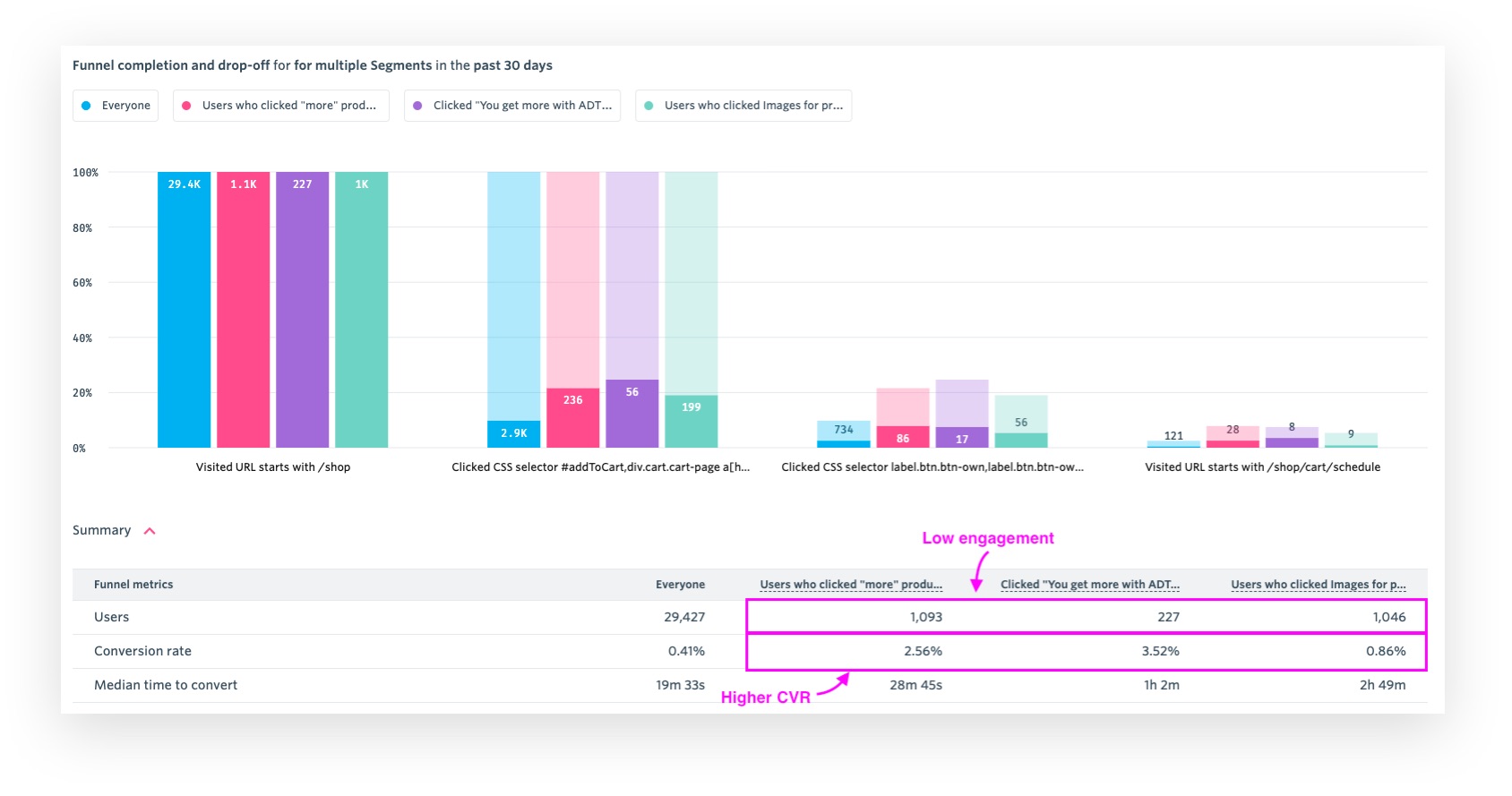
I used funnel analysis in Fullstory to understand where users were dropping off on the PDP. The data revealed something important: certain product detail content elements were getting low engagement — but users who did engage with those elements converted at much higher rates.
This wasn't a traffic problem. It was a visibility and content problem. The right information existed, but users weren't finding or engaging with it.
User Testing
Through moderated and unmoderated testing sessions I directed the team to conduct, we confirmed the hypothesis: additional explanatory product details and illustration of benefits would help customers make informed purchase decisions and give them confidence. Home security is a considered purchase. Customers needed to understand what they were getting before they'd commit.
I also instructed my team to conduct heuristic assessments of competitor websites and research industry best practices — both to validate the direction and to identify tactics we hadn't yet explored.
Design & Solution
Three Areas for Improvement
Based on research, my team and I identified three key opportunities:
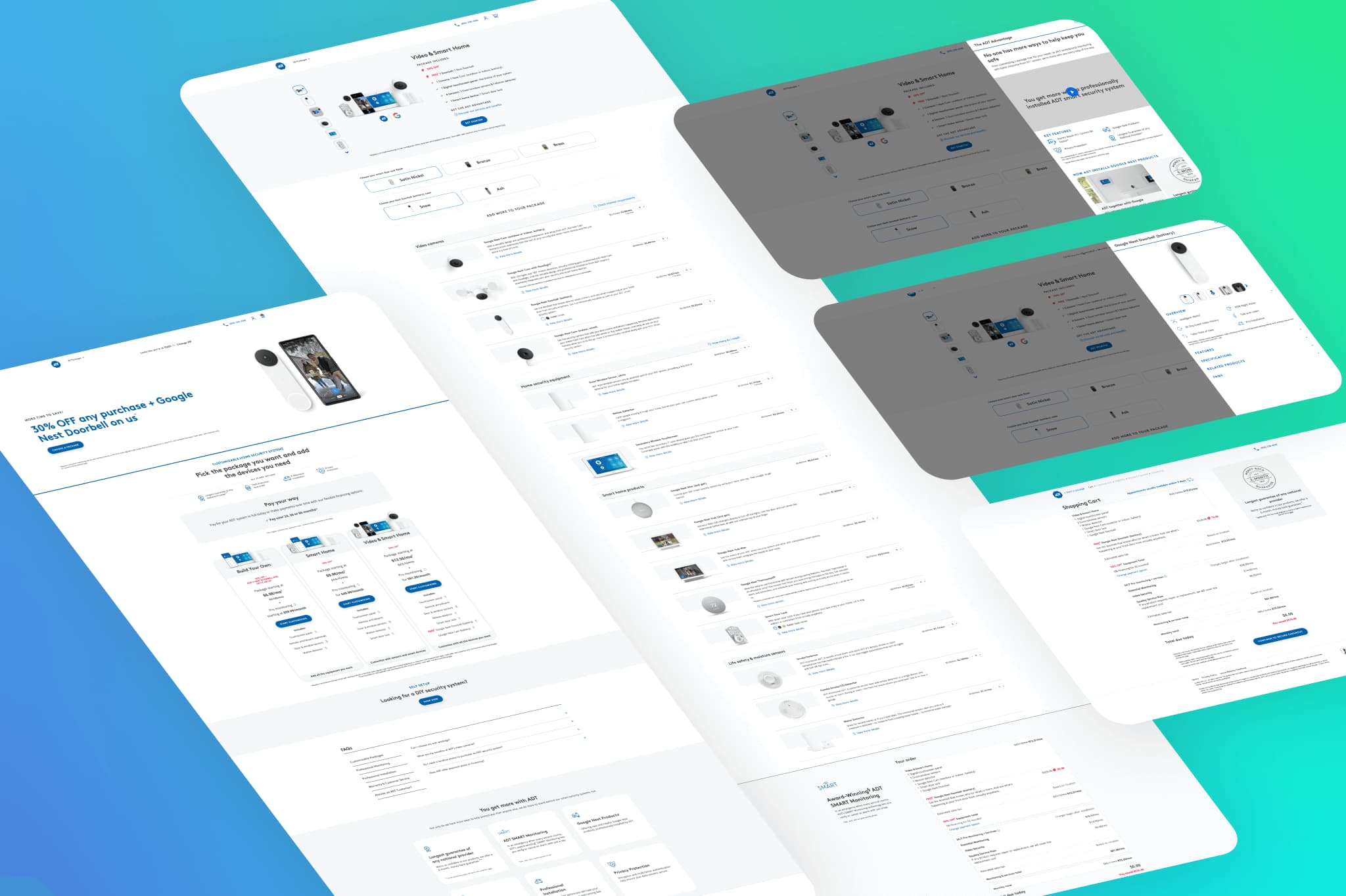
1. Attractive and Informative Package Image Carousels
Product photography wasn't doing enough work to sell the package. We redesigned the image carousel to better communicate what's included and why it matters — turning a passive gallery into an active selling surface.
2. The ADT Advantage Drawer
Customers needed a clear answer to "why ADT over anyone else?" We created a dedicated content section surfacing ADT's unique selling propositions — the differentiators that justified the purchase.
3. Robust Product Detail Drawers
Each package needed a clear breakdown of its components, features, and benefits. We built expandable detail drawers that gave customers the depth they needed without overwhelming the above-the-fold experience.
The new PDP layout launched in Spring 2022 across several development sprints, rolling out the three enhancements progressively.
Leadership & Collaboration
As Director, I set the strategic vision and owned the outcome:
- Directing research: Structuring the Fullstory analysis, designing the user testing plan, and ensuring findings were actionable, not just observational
- Shaping the solution: Translating behavioral data and user feedback into three concrete design directions rather than a long backlog of improvements
- Executive communication: Keeping leadership aligned on strategy, rationale, and expected impact before, during, and after launch
- Identifying follow-on opportunities: Post-launch, I identified an opportunity to amplify conversion gains by increasing visual emphasis on the new elements — added to the design roadmap
Impact & Outcomes
The Result
The PDP overhaul contributed to a 400% year-over-year increase in ADT e-commerce sales.
Behavioral analytics confirmed the mechanism: users who engaged with the new features — the image carousels, ADT Advantage Drawer, and Product Add-on Detail Drawers — converted at higher rates than those who didn't. Qualitative user testing confirmed that the enhancements drastically improved the experience and positively affected purchase decision-making.
The project demonstrated that the conversion problem wasn't a pricing or product issue — it was an information architecture and storytelling problem. Users who got the right context converted. The design work made that context accessible for everyone, and established a template for how the team approached e-commerce design going forward: lead with behavioral data, validate with qualitative research, then design to close the gap.
ADT E-commerce PDP Optimization — silent screen recording, video 2 of 1